Latest Pyramid Surprise
For over a century, it was assumed the Great Pyramid of Giza had given up its architecture. Three chambers, a few shafts, done. That assumption just collapsed — not because of a lucky shovel strike, but because scientists finally learned to ask the stone a question without touching it.
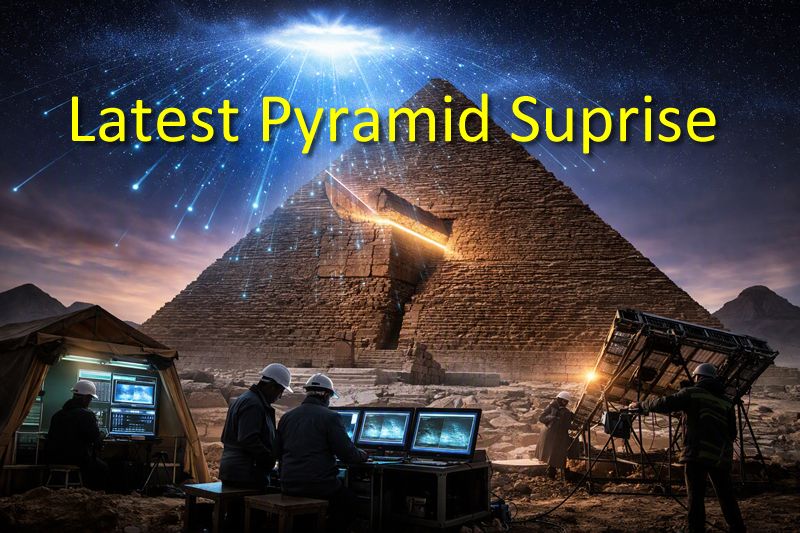
In 2023, the ScanPyramids project used cosmic-ray muons — subatomic particles raining down from space, harmless and free — to trace a 30-foot corridor sealed above the Great Pyramid’s main entrance for 4,500 years. Follow-up scans with radar, ultrasound, and electrical resistivity confirmed its shape without a single drill bit touching the limestone. Egyptologist Zahi Hawass now says the corridor leads to a sealed door, and has promised a “great discovery” that will “rewrite a chapter” of pharaonic history before the end of 2026.
Then, this spring, researchers from Cairo University and Munich’s Technical University pointed the same non-invasive tools at Menkaure — the smallest and least-studied of the Giza three. Behind an oddly polished patch of granite on its eastern face, they found two air-filled voids, one of them elongated and corridor-like, sitting just over a meter beneath the surface. Nothing about their position lines up with any known chamber. Scholars have wondered for decades whether Menkaure hides a second entrance. This is the first physical evidence that they were right to wonder.
What makes this moment worth pausing on isn’t only the mystery — it’s the reversal underneath it. For two centuries, “solving” a pyramid meant breaking into it. Every generation of explorers, from treasure hunters to dynamite crews, assumed access required destruction. Today’s researchers are proving the opposite: that patience, precision, and respect for the object can reveal more than force ever did. Muons that have been falling from space since before Egypt existed are now doing the work of the pickaxe — and doing it without erasing a single clue for the next generation to read.
There’s something quietly instructive in that. Hawass has been blunt about what these scans do not show: no evidence of aliens, only the ingenuity of Old Kingdom engineers who moved multi-ton blocks with ramps, levers, and a grasp of geometry we’re still reverse-engineering. When something this old and precise turns up, the temptation is to reach for the exotic explanation. The data keeps pointing back to something more grounded and, honestly, more remarkable: human beings, four and a half millennia ago, building with a confidence that still humbles engineers today.
The door in the Great Pyramid hasn’t opened yet. The voids in Menkaure haven’t been named. But both are reminders that a civilization doesn’t have to be understood to be honored — and that some of the oldest structures on Earth still have the humility to say: not yet, look closer, look carefully. In an age obsessed with speed, the pyramids are teaching patience one muon at a time.
Sources: ScanPyramids Project (Cairo University / TU Munich); Zahi Hawass, Sharjah International Book Fair, Nov. 2025; ScienceDaily; Ancient Origins