articles

The NOW From Three Teachers

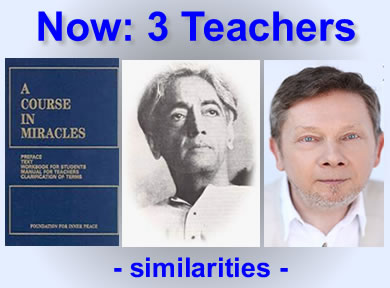
The NOW From Three Teachers The ‘now’, or the eternal present instant, is the only space we ever are in reality. Paradoxically, the context in which we use the word ‘we’ refers to our ego mind, which has become crippled by its dependence on thought (a product of the past), which is based entirely on the past, or on the projected past… which is the future. The ego mind (as opposed to our universal mind) is incapable of being in the present ‘now’. This one observation, obviously true, presents us with a frustratingly simple challenge…why we are we simply unwilling or incapable to experience the present now? We treat the now as an unimportant gap between the past and the future to be avoided… but the past is gone…and the future never arrives. But the reality is we are evermore in the ‘now’, which we refuse to recognize. What is insanity, if not this? I’d like to look at the concept of time from the perspective of three of the greatest world teachers of our time… A Course in Miracles, Jiddhu Krishamurti, and Eckhardt Tolle. I believe all are saying the same thing on this topic with different words, the Course from a vastly broader array of teachings, and Krishnamurti and Tolle from their respective teachings which are not only very similar, but emphasize the ‘now’ as one of, or in Tolle’s case, their primary concept. ///////////  A Course in Miracles: (Chapter 13 – The Function of Time)  ///////////// (Note: […]
krishnaji stream of life
articles

Stream of Life vs Stream of Thought

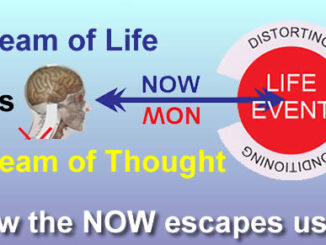
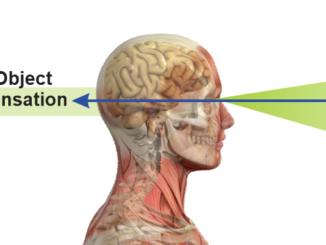
This graphic is an imperfect representation of the words of Krishnamurti, Tolle, and Johan Lem. The central idea is the same one repeated by K for his entire life, that the ‘now’ escapes us as our stream of thought runs away from the now into the past or future. By not seeing completely what is before us, we accumulate incomplete memories which condition us even more. K’s message was one of direct observation… without will or motive… and without thought which has become a ‘distraction’. Of course, until one is capable of this, it is only conjecture and speculation. Some people like to draw diagrams in order to understand it. There are three pages in this PDF.  Click here to open/download this PDF  
articles

68 Years Ago K Warns of Ideation

Yesterday’s words intended for today’s problems. Taken verbatim and with respect from ‘The First and Last Freedom‘ Jiddu Krishnamurti 1953 QUESTION 1: ON THE PRESENT CRISIS Question: You say the present crisis is without precedent. In what way is it exceptional? Krishnamurti: Obviously the present crisis throughout the world is exceptional, without precedent. There have been crises of varying types at different periods throughout history, social, national, political. Crises come and go; economic recessions, depressions, come, get modified, and continue in a different form. We know that; we are familiar with that process. Surely the present crisis is different, is it not? It is different first because we are dealing not with money nor with tangible things but with ideas. The crisis is exceptional because it is in the field of ideation. We are quarrelling with ideas, we are justifying murder; everywhere in the world we are justifying murder as a means to a righteous end, which in itself is unprecedented. Before, evil was recognized to be evil, murder was recognized to be murder, but now murder is a means to achieve a noble result. Murder, whether of one person or of a group of people, is justified, because the murderer, or the group that the murderer represents, justifies it as a means of achieving a result which will be beneficial to man. That is we sacrifice the present for the future – and it does not matter what means we employ as long as our declared purpose is to […]
articles

Direct Observation

Krishnamurti’s statement ‘the observer is the observed’ baffled me for many years, and still I have not fully accepted it, or come to terms with its implications. Have you? But I think what he meant and was describing, and that we are terrified to admit, is that ‘we are the world, and the world is us’. Therefore, there is nothing we can change about it. The observer, which is our mind, is a collection of the past observations we have made, the conditionings which are now largely unconscious in us. I found this video below from Saanen 1981 to be refreshingly direct, in which he makes several statements of what actually is the ‘truth’. Like all true spiritual teachings, I believe the truth is simple, and what K is describing is so, however our minds fight to find the complexity in it, and failing to do so, abandon it as below our intellect. To look directly at what K is saying seems to me to take great courage, as the implications of of doing so are to question the foundation which our mind (since there is only one) is made of and how it operates. To see that it is not capable of overcoming its problems, is to begin to distance from it. I believe that to distance ourselves from the mind that we have created, is likely the greatest fear the human being is capable of. A Course in Miracles alludes to this fear in many places, but advises […]
articles

Applying Krishnamurti’s Wisdom

2004 Letter from Johan Lem Issue No. 24, 2004-2005 of the Krishnamurti International Link magazine, contained the letter below from Johan Lem. I don’t know who Mr. Lem is, but this letter struck me as the most common-sense approach to applying K’s work that I have ever seen. To me, this letter is worth decades of reading and studying, if it is applied. I suspect however, that until one has done decades of reading and studying, letters like this mean nothing. I hope it can save you more time than it saved me! Understanding, or Living the Teachings? After having read a few articles in different issues of The Link, I have the impression that the goal of many authors is to understand the teachings, and their approach is often very intellectual and complicated. My approach is simple. Many years ago I used the teachings to understand myself. This understanding is not intellectual, but direct; it occurs through seeing what is happening one’s psyche when it happens. This seeing comes through a state of awareness when inner and outer senses are open, alert, interested to see or experience what is taking place there and then, no matter whether it is pleasant or unpleasant. From that moment on, if one is alert in daily life, the teachings are no longer so important: ‘what is’ has taken over the teaching job. As in this awareness thought has automatically calmed down, such a state cannot be found through any activity of thought. There […]
krishnamurti
articles

Krishnamurti – The Observer is the Observed

‘The Observer is the Observed’. I struggled for years to understand what Krishnamurti meant by this cryptic statement that he repeated often. This is what I think he meant, although I may be missing the essence of it. We are the world, and the world is us, we are not different from what we are ‘seeing’, if we are in fact seeing it at all. I believe his message was to see ‘what is’, not ‘what should be’. When we see ugliness in ourselves our minds immediately escape into ‘what should be…’, what I will do it improve myself… but this (almost instantaneous are largely unconscious) escape prevents us from seeing clearly in the present moment, rather we are escaping into the past or future. It was part of Krishnamurti’s message that only by seeing what is, what actually is, can we can begin to make progress in understanding ourselves, which is the first step in real change. This video, and other incredibly well produced videos on Krishnamurti, are available through the Krishnamurti Foundation of America ©: https://theimmeasurable.org/
articles

3 Systems of Thought

The PDF embedded in this page presents my interpretation of the three modes of thought available to us. The first is the standard mode of thought in this world. Our separation from God created such unimaginable guilt that this world literally had to be projected outside of us. The one mind of God that we all share then became split into billions of ‘minds’ and bodies, all of which appear to be separate from us. When we observe any person, object, idea, or thing outside of us our brain immediately ‘recognizes’ it, names it, recovers past memories or stored thoughts about it, which colors our interpretation of it. The idea at this point becomes more important than the thing we observing, which we no longer see rightly. A favorite plan of the ego is to hold grievances, which we tell ourselves will be healed when the other person ‘changes’, which they never will. The vast majority of the world is trapped in this circular thinking system. Under A Course in Miracles thought system, recognition, naming, and ideation (recovery of good or bad memories) still occurs, however at this point we are watching these patterns unfold in our minds and make a conscious decision to turn this entire encounter over to the Holy Spirit. The Holy Spirit sees all things as either Love, or a call for Love. Thus the Holy Spirit interprets the other persons ‘sins’ as illusory dreams that represent a call for Love, and that require not punishment […]
Tired woman slumping over desk
articles

Cherish Your Morning Anguish

Usually a good sleeper, at 64 and after several years of a declining business which is now in a financial death spiral, I’ve developed a depressing habit of waking up at either 1:30 AM or 3:30 AM and beginning the long solitary trek through ‘morning anguish’. Morning anguish is my term for the early hour’s crashing waves of negativity that befalls those whose internal guidance system chooses the self-defeating rituals of worry to sleep, anguish to rest, and suffering to slumber. Why this occurs at random intervals is a partial mystery. The other part of the mystery is not really such a mystery. Maslow, bless his tedious scientific soul, wisely asserted that our needs are organized as a hierarchy, with the physiological needs (food, water, shelter, warmth) at the bottom. As a baby boomer product of the 1950’s, physiological needs were always relatively easy to meet. Jobs were plentiful and confidence blew like the wind. Life was challenging but there was always the unspoken assumption that the physiological material goods (like food) would flow to us by divine right and sanctity of our country of origin. If anything really went seriously bad your Dad would fix it, and if not he could still beat up anyone else’s Dad. Realistically, most of us probably won’t get to Maslow’s ‘self-actualization’ level, esteem happens intermittently on a rare good day, love and belonging is never all that sure, and we’ve all broken the safety rules with impunity in the name of fun. But […]